
Saudi Arabia’s work visa system has undergone significant transformation as part of Vision 2030, introducing a skill-based classification framework, digital processing platforms, and reformed sponsorship rules. Whether you are an employer seeking to hire foreign talent or a professional planning to work in the Kingdom, understanding the current visa types, requirements, and costs is essential. For short-term tourism, the Saudi eVisa is a simpler option. This guide covers everything you need to know about obtaining a Saudi Arabia work visa in 2026.
Saudi Arabia Work Visa Types
Saudi Arabia offers several visa categories for foreign workers, each designed for different employment situations and durations. If you are visiting for tourism, see the Saudi Arabia Tourist Visa guide. For short business trips, the Saudi Arabia Business Visa may be more appropriate.
Employment Visa (Standard Work Visa / Type 18)
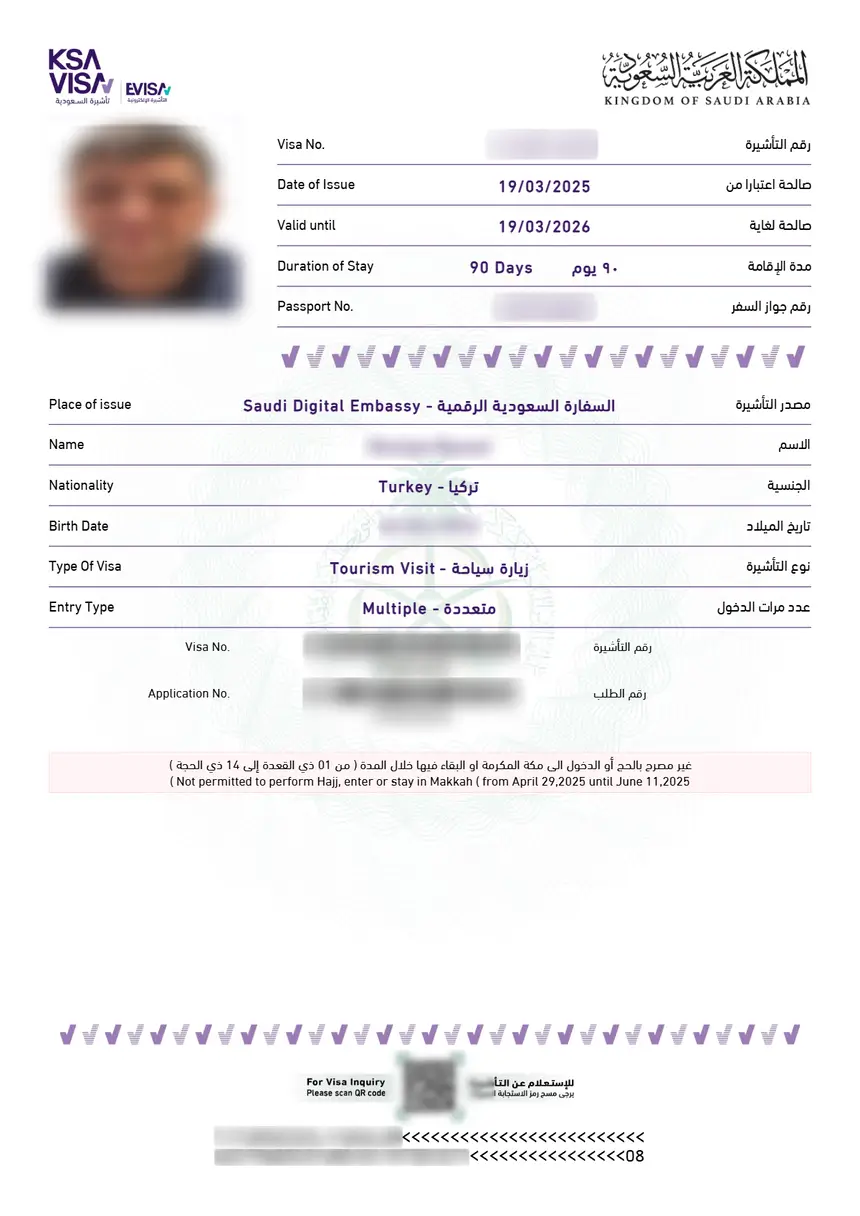
The Employment Visa is the primary long-term work visa for foreign nationals taking up full-time roles in Saudi Arabia. The process begins with a Type 18 Work Visit Visa – a 90-day single-entry visa stamped at a Saudi consulate. After entering the Kingdom, the worker completes in-country medical screening, biometric capture, and contract registration, then converts to an Iqama (residency permit).
Key features of the Employment Visa:
- Validity: Issued for one year and renewable annually
- Iqama issued: Grants legal residency, access to services, and the ability to sponsor dependents
- Subject to skill-based classification: Must be classified under one of three tiers (High-Skilled, Skilled, or Basic)
- Ideal for: Full-time professional and technical roles, mid- to long-term employment contracts, employees relocating with family
Since Q1 2026, the Iqama is issued as a five-year physical card decoupled from annual permit renewal cycles. Status updates are handled digitally through the Muqeem platform and the Tawakkalna super-app, which stores a digital Iqama accepted across government and most private establishments.
Temporary Work Visa
The Temporary Work Visa serves as a flexible, short-term option for foreign professionals entering the Kingdom for limited durations. Unlike the standard Employment Visa, it is not linked to an Iqama and lies outside the scope of the new skill-based reforms.
Key features:
- Validity: 90 days, extendable once for another 90 days (maximum 180 days total)
- No Iqama issued: Cannot provide Saudi residency status
- No skill-based classification required
- Cost: SAR 1,000 (approximately USD 266)
- Ideal for: Project-based technical work, equipment installation, on-site training, and consultancy
Employers must hold a valid Commercial Registration (CR), maintain at least a Green Nitaqat status, comply with Wage Protection System (WPS) regulations, and have sufficient visa quota in the Qiwa platform. Visa holders cannot bring dependents on this visa type.
Freelancer Visa
Launched alongside the Premium Residency ecosystem, the Freelancer Visa allows self-employed professionals in qualifying creative, technical, and consulting fields to operate in Saudi Arabia without a corporate sponsor. This visa type reflects the Kingdom’s growing recognition of independent professionals and the gig economy.
Premium Residency
Saudi Arabia’s Premium Residency programme, expanded significantly in 2024, offers an alternative to employer-sponsored work visas. Two main tiers are available:
- Permanent Premium Residency: One-time fee of SAR 800,000 (approximately USD 213,000)
- Renewable Premium Residency: SAR 100,000 per year (approximately USD 26,600)
Both grant the right to live, work, own residential property, sponsor family members, and conduct business without a Saudi partner.
The 2024 expansion introduced five category-based tiers at SAR 4,000 each, valid for up to five years:
- Special Talent: Monthly compensation above SAR 80,000 in healthcare, research, or executive leadership
- Gifted: Recognized talent in creative or specialized fields
- Investor: Minimum capital deployment with Saudi job-creation thresholds
- Entrepreneur: Business ownership with viable business plans
- Real Estate Owner: Full ownership of residential property worth SAR 4 million or more
Skill-Based Classification System (2026)
In July 2025, Saudi Arabia’s Ministry of Human Resources and Social Development (HRSD) implemented a mandatory three-tier skill-based classification system for all long-term expatriate work permits. This replaces the previous professional vs. non-professional model with a framework based on the Saudi Standard Classification of Occupations (SSCO).
| Tier | Target Roles | Education | Experience | Monthly Salary | Age Limit |
|---|---|---|---|---|---|
| High-Skilled | Doctors, engineers, IT specialists, executives | Bachelor’s degree or above | 5+ years | SAR 15,000+ | None |
| Skilled | Technicians, mid-level supervisors, craftsmen | Secondary education or vocational cert | 2+ years | SAR 7,000-14,999 | None |
| Basic | Entry-level and manual labor | No formal education required | None | SAR 3,000-6,999 | Below 60 years |
The 70-point threshold for High-Skilled roles is an automated gatekeeper within the Qiwa platform. Employers must classify each expatriate role correctly – incorrect classifications may result in fines or hiring restrictions.
The High-Skilled tier offers the most benefits: dependent work permits, accelerated Premium Residency tracks, and reduced Nitaqat weight. The Basic tier carries the heaviest restrictions and is being phased out of sectors targeted for full Saudization.
Work Visa Requirements and Documents
The standard documentation package for a Saudi work visa includes (for tourist visa requirements, see Saudi eVisa Requirements):
- Passport: At least six months of remaining validity with at least two blank pages
- Educational certificates: Highest level claimed, attested by the issuing university, home country’s ministry of foreign affairs, and the Saudi Cultural Attaché or embassy
- Police clearance certificate: Issued within the previous six months by the home country’s national police authority
- Medical fitness certificate: From a GAMCA-approved clinic (for South Asian and certain Southeast Asian nationals), screening for HIV, hepatitis B and C, tuberculosis, syphilis, and malaria
- Arabic-language employment contract: Signed by both parties, registered on Qiwa, and matching the SSCO occupation code
- Passport photographs: Saudi consular specifications (white background, 6×4 cm, biometric framing)
For senior roles in regulated sectors, additional certifications may be required from bodies such as the Saudi Council of Engineers, the Saudi Commission for Health Specialties, or SOCPA. These licensing reviews can extend the timeline by four to twelve weeks.
A critical requirement is the attestation chain – each document must be attested in strict order: issuing institution, then home-country foreign ministry (or apostille for Hague Convention signatories), then Saudi embassy. Skipping a step or using an unapproved translator results in rejection and can require restarting the entire chain.
How to Apply for a Saudi Work Visa
The application process follows a structured digital workflow through Saudi Arabia’s key platforms: Qiwa (labour approvals), Muqeem (residency management), and Absher (government services).
Step 1: Employer Quota and Authorization
The employer must hold a block visa quota – an allocation of available foreign-worker slots calculated against its commercial registration, Nitaqat compliance band, and Saudization ratio. Companies in Platinum or High Green bands receive faster quota approvals. Once a quota is granted, the employer issues a visa authorisation number through Qiwa, transmitted to the Ministry of Foreign Affairs (MOFA) Enjaz portal.
Step 2: Embassy Application
The candidate books a slot at the Saudi embassy or accredited visa centre (VFS, Tasheer, or Etimad) in their home country and submits all required documents. The consulate stamps the Type 18 visa onto the passport, and the worker enters Saudi Arabia within the 90-day validity window.
Step 3: In-Country Conversion to Iqama
Within 90 days of arrival, the employer converts the Type 18 visa into an Iqama. This requires:
- Second medical examination at an MHRSD-recognised clinic in the Kingdom
- Fingerprint capture at the General Directorate of Passports (Jawazat)
- Enrolment in the National Address system
- Registration of the employment contract on Qiwa
- Iqama card issuance through the Muqeem platform
Saudi Work Visa Fees and Costs
The total employer cost for maintaining a foreign worker is a significant factor in Saudi hiring economics. Here is the current fee breakdown:
| Fee Component | Amount (SAR) | Amount (USD approx.) | Frequency |
|---|---|---|---|
| Visa issuance fee | 2,000 | 533 | One-time |
| Work permit levy (maqabel) | 9,600 | 2,560 | Annual |
| Iqama renewal | 650 | 173 | Annual |
| Medical insurance | 2,000-10,000 | 533-2,667 | Annual |
| Temporary Work Visa | 1,000 | 267 | Per application |
Companies in Platinum and High Green Nitaqat bands pay the base levy unchanged. Companies in lower bands face escalating surcharges – a Red-band company can see its effective per-worker cost double, and quota access may be suspended entirely.
All-in annual cost for a single foreign worker, excluding salary, typically ranges from SAR 15,000 to SAR 30,000 (USD 4,000 to USD 8,000). Senior expatriates in regulated industries (healthcare, banking, engineering) frequently exceed SAR 35,000 once professional licensing fees and council attestations are added.
Saudi Work Visa Processing Time
Processing times vary depending on visa type and the applicant’s country of origin:
- Temporary Work Visa: 3-5 business days
- Standard Employment Visa (Type 18): 2-4 weeks for consular stamping, plus 30-90 days for in-country Iqama conversion
- Premium Residency: 60-90 business days for processing, plus 2-4 weeks for card issuance after fee payment
- Professional licensing (regulated sectors): Additional 4-12 weeks
Factors that can extend processing include document attestation delays, GAMCA medical appointment availability, and Qiwa quota approval timelines.
Kafala System and Recent Reforms
The kafala (sponsorship) system has been the structural backbone of Gulf labour migration since the 1950s. The 2021 Labour Reform Initiative introduced the most significant adjustments:
- Job mobility without sponsor consent: Available after one year of service or upon contract expiry, processed through Qiwa
- Digital exit and re-entry visa issuance: Through Absher, without requiring the employer’s signature
- Final exit visa requests: Can be initiated by the worker after contract completion
Subsequent reforms have expanded worker protections further. A 2025 amendment eliminated the three-year re-entry ban for workers who had overstayed earlier exit permits. The 2026 update introduced 30-day grace periods for visa overstays and real-time status tracking via Absher.
The dependent work permit, introduced in 2026, allows qualified spouses and adult children on family-sponsored Iqamas to obtain work permits – a major change that addresses one of the most frequently cited reasons senior expatriates declined Saudi offers.
These reforms are not a full dismantling of kafala. Workers still cannot change employers within the first year unless specific protections are invoked (unpaid wages over three months, contract violations, employer fraud). Domestic workers and farmworkers remain outside the Labour Law under weaker protections.
Saudization (Nitaqat) and Its Impact
Saudization – formally the Tawteen programme administered through the Nitaqat classification system – is the most consequential constraint on foreign hiring. Each company is assigned a band (Platinum, High Green, Medium Green, Low Green, or Red) based on the percentage of Saudi nationals employed.
A company’s band determines:
- Whether new visa quotas can be issued
- Per-worker fees charged
- Access to government tenders
- Eligibility for foreign recruitment
The 2025 update sharply expanded sectoral Saudization quotas. For example, dental practices moved to 45-65% Saudi employment, engineering practices to 30%, and accounting practices to 40% (rising 10 percentage points annually until 2028). Certain roles like secretaries, data entry clerks, and translators are now largely restricted to Saudi nationals.
For multinational employers, the Saudi-national hire is no longer discretionary – it is a regulatory prerequisite for issuing the next foreign visa. Companies routinely structure hiring as paired Saudi-foreign placements, with HRDF subsidies offsetting up to 50% of Saudi training costs.