
Extending your Saudi Arabia visa depends on your visa type. The Saudi eVisa cannot be extended in-country – you must exit and re-enter within your 1-year validity. Other visa types (visit, family, business) can be extended through your sponsor via the Absher or Muqeem portals. This guide covers every extension method, fees, overstay penalties, and step-by-step processes for 2026.
Can You Extend a Saudi Arabia Visa?
Whether you can extend your Saudi visa depends entirely on the type of visa you hold. Saudi Arabia issues several visa categories, each with different extension rules:
| Visa Type | Can You Extend? | Extension Method |
|---|---|---|
| Tourist eVisa | No in-country extension | Exit and re-enter on same multiple-entry visa |
| Family Visit Visa | Yes, once | Sponsor applies via Absher |
| Business Visit Visa | Yes | Sponsor applies via MOFA portal |
| Work Visa / Iqama | Yes | Employer renews via Muqeem |
| Transit Visa | No | Must depart within 48-96 hours |
| UK ETA | No extension needed | Valid for 180 days total across 730 days |
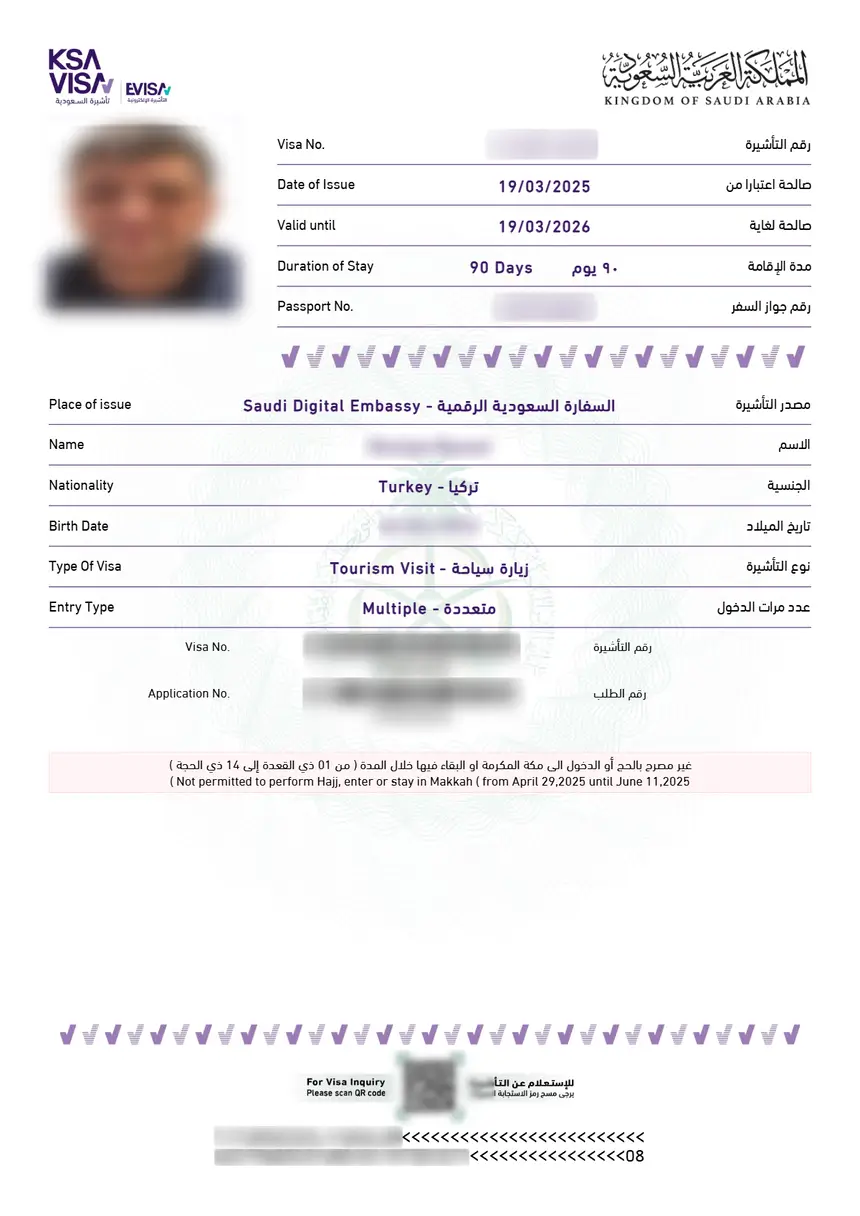
The Saudi eVisa is the most common visa for tourists. It costs SAR 395 (~USD 105), is valid for 1 year with multiple entries, and allows a cumulative stay of 90 days total. The 90-day limit is cumulative – it does not reset each time you leave and re-enter. Once you have used all 90 days, you cannot re-enter on that eVisa.
For full eVisa details, see our Saudi eVisa complete guide and eVisa requirements pages.
Extending Your Saudi eVisa Stay
The Saudi eVisa does not allow in-country extension. However, because it is a multiple-entry visa valid for 1 year, you can use the exit-and-re-entry strategy to manage your stay duration.
How the Exit-and-Re-Entry Strategy Works
The eVisa allows 90 cumulative days of stay within its 1-year validity period. Each time you leave Saudi Arabia, the days you have already spent in the country remain counted. The key insight is that you can spread your 90 days across multiple trips throughout the year.
Example: You enter Saudi Arabia on January 1 and stay for 45 days. You fly to Bahrain on February 15 and return on February 20. You now have 45 days used plus your new entry. You can stay up to 45 more days (total 90) before your eVisa expires or your cumulative limit is reached.
Neighboring Countries for Quick Exits
Common exit destinations for eVisa holders who need to leave and re-enter:
- Bahrain – Connected via King Fahd Causeway (drive across, ~30 minutes from Dammam). No visa required for most nationalities. The cheapest and fastest option.
- UAE – Direct flights from Riyadh, Jeddah, or Dammam. Visa on arrival for most eVisa-eligible nationalities.
- Oman – Flights from major Saudi cities. Visa-free or visa-on-arrival for most nationalities.
- Jordan – Direct flights available. Visa on arrival for many nationalities.
- Kuwait – Short flights from eastern Saudi Arabia. Visa on arrival for some nationalities.
Important Limitations
- The 90-day cumulative count does not reset when you exit. Only unused days remain.
- Once all 90 days are used, the eVisa is effectively exhausted even if the 1-year validity has not expired.
- You need a new eVisa (SAR 395) to get another 90 days after the current one is used up.
- Airlines and immigration track your cumulative stay. Attempting to re-enter after using all 90 days will result in denial of entry.
For information on processing times, see our Saudi visa processing time guide.
Extending a Saudi Visit Visa (Non-eVisa)
If you entered Saudi Arabia on a visit visa obtained through an embassy or the KSA Visa portal (not the tourist eVisa), extension is possible through your sponsor (kafeel).
Extension Process
- Your sponsor initiates the extension through the Absher portal (absher.sa) or by visiting a Jawazat (Passport Directorate) office
- Required documents: Your passport (valid for at least 6 months), current visa copy, sponsor’s ID
- Extension period: Typically 30 days per extension
- Fee: SAR 100 (~USD 27) per extension
- Processing time: Usually same-day or within 48 hours
Visit Visa Extension Limits
- Most visit visas can be extended up to 3 times (total additional 90 days)
- Maximum total stay depends on the original visa type and conditions
- Extensions must be applied for before the current visa expires
- Expired visas cannot be extended – you must exit and apply for a new visa
Family Visit Visa Extension
The Saudi family visit visa has specific extension rules that differ from regular visit visas.
For Relatives (First Degree)
- Initial validity: Up to 180 days
- Extension: Can be extended once for an additional 30 days
- Maximum total stay: 210 days (180 + 30)
- Fee: SAR 100 for the extension
For Non-Relatives (Friends)
- Initial validity: Up to 90 days
- Extension: Can be extended once for 30 days
- Maximum total stay: 120 days (90 + 30)
- Fee: SAR 100 for the extension
How to Extend
The sponsor (your family member or friend in Saudi Arabia) must:
- Log in to the Absher portal (absher.sa)
- Navigate to Services > Passport > Extend Visit Visa
- Enter the visitor’s passport number and visa details
- Pay the SAR 100 extension fee online
- The extension is processed electronically
Alternatively, the sponsor can visit a Jawazat office in person with the required documents.
Saudi Visa Extension Fees
| Action | Fee (SAR) | Fee (USD approx.) |
|---|---|---|
| New eVisa | SAR 395 | ~USD 105 |
| Visit visa extension (30 days) | SAR 100 | ~USD 27 |
| Family visit visa extension | SAR 100 | ~USD 27 |
| Exit/re-entry visa (residents) | SAR 100-200 | ~USD 27-53 |
| Final exit visa (residents) | Free | Free |
| Overstay fine (first 90 days) | SAR 100/day | ~USD 27/day |
| Overstay fine (91-180 days) | SAR 200/day | ~USD 53/day |
All fees are paid online through the Absher portal or at Jawazat offices. Credit and debit cards are accepted for online payments.
For a complete breakdown of eVisa costs, visit our Saudi eVisa fees guide.
What Happens If You Overstay Your Saudi Visa
Overstaying your Saudi visa is taken very seriously by Saudi authorities. The consequences escalate the longer you remain in the country illegally.
Overstay Penalty Structure
| Duration of Overstay | Fine per Day (SAR) | Additional Consequences |
|---|---|---|
| First 90 days | SAR 100 (~USD 27) | Warning, fine accumulation |
| 91-180 days | SAR 200 (~USD 53) | Detention risk, deportation proceedings |
| Beyond 180 days | SAR 200+ | Detention, deportation, entry ban |
Additional Consequences
- Entry ban: Typically 1 to 5 years depending on overstay duration
- Detention: Overstayers may be held in immigration detention facilities
- Deportation: At your own expense, including flight costs
- Future visa denial: A Saudi overstay record affects applications to Saudi Arabia and other GCC countries (UAE, Bahrain, Kuwait, Qatar, Oman)
- Employer penalties: If on a work visa, both the employee and employer face fines
- Sponsor liability: For visit visa holders, the sponsor (kafeel) may face penalties
How Overstay Is Detected
Saudi immigration systems track entry and exit dates digitally. Overstayers are flagged when:
- Attempting to exit the country at airports or land borders
- Stopped at internal checkpoints
- Checked during routine traffic stops
- Employer or sponsor reports discrepancy
The fine must be paid before you can leave the country. Unpaid fines result in detention until the amount is settled.
How to Avoid Overstaying
Preventing an overstay is far easier than dealing with the consequences. Follow these practical steps:
-
Track your days carefully. Count from your entry stamp date, not your visa issuance date. Saudi immigration counts days from entry, including the entry day itself.
-
Set calendar reminders. Set alerts at 60 days, 75 days, and 85 days of your stay to ensure you exit before reaching 90 days on an eVisa.
-
Plan your exit early. Do not wait until the last day. Flight delays, border closures, or unexpected events could prevent timely departure.
-
Know your visa type. Different visas have different rules. An eVisa has a 90-day cumulative limit; a family visit visa has a different maximum stay.
-
Check your remaining days. If you have exited and re-entered Saudi Arabia, calculate your remaining days carefully. The count is cumulative.
-
Apply for extension before expiry. For non-eVisa types, apply at least 7 days before your visa expires to allow processing time.
-
Keep copies of all travel documents. Maintain digital copies of your passport, visa, entry stamps, and boarding passes for reference.
Frequently Asked Questions
Can I extend my Saudi eVisa while inside Saudi Arabia?
No. The Saudi eVisa cannot be extended while you are in Saudi Arabia. Because it is a multiple-entry visa valid for 1 year, the only way to extend your stay is to exit the country and re-enter on the same eVisa. Your cumulative stay limit of 90 days does not reset – only unused days remain available.
How many times can I enter Saudi Arabia on one eVisa?
There is no limit to the number of entries on a Saudi eVisa within its 1-year validity period. However, your total cumulative stay cannot exceed 90 days across all entries. Once you have used 90 days, the eVisa is exhausted regardless of how many days remain on the 1-year validity.
What is the cheapest way to leave and re-enter Saudi Arabia on an eVisa?
The cheapest option is driving across the **King Fahd Causeway** to Bahrain from the Eastern Province (Dammam/Khobar area). The causeway toll is approximately SAR 25-35 (~USD 7-9), and Bahrain does not require a visa for most nationalities. You can cross and return the same day.
What happens if I overstay by just one day?
Even a single day of overstay results in a fine of **SAR 100 (~USD 27)**. While a 1-day overstay typically does not result in detention or deportation, it creates a record that could affect future visa applications. Pay the fine at the airport before departure or through the Jawazat system.
Can I extend a Saudi work visa or iqama?
Yes. Work visa and iqama (residence permit) extensions are handled by your employer through the **Muqeem portal** (muqeem.sa). The employer initiates the renewal process, which includes updated medical insurance and payment of government fees. Extensions are typically for 1 year.
Can I switch from a tourist eVisa to a work visa while in Saudi Arabia?
No. You cannot change your visa status while inside Saudi Arabia. To obtain a work visa, you must exit the country and apply through the standard work visa process via your employer and the Saudi embassy. The eVisa is strictly for tourism, Umrah (outside Hajj season), and short visits.
Do I need health insurance for a visa extension?
For eVisa holders, health insurance is included in the SAR 395 eVisa fee and covers the 1-year validity period. For visit visa extensions, health insurance coverage depends on your original visa conditions. Check with your sponsor or the Jawazat office to confirm coverage during the extended period.
Can GCC residents extend their Saudi eVisa?
GCC residents who obtained a Saudi eVisa follow the same rules as all other eVisa holders: 90 cumulative days, 1-year validity, no in-country extension. However, GCC residents may have additional visa-on-arrival options that are not available to other nationalities.
Summary
Extending your stay in Saudi Arabia depends on your visa type. eVisa holders cannot extend in-country but can use the exit-and-re-entry strategy within their 1-year multiple-entry validity. Visit visa holders can extend through their sponsor via Absher for SAR 100 per 30-day extension. Family visit visas allow one extension of 30 days. Overstaying carries serious consequences – fines starting at SAR 100/day, detention, deportation, and future entry bans. Plan ahead, track your days, and apply for extensions before your visa expires.
For more Saudi visa information, explore our guides on Saudi eVisa fees, visa processing times, and tourist visa options.