
A Saudi Arabia transit visa is a short-term travel document that allows passengers to pass through Saudi airports during connecting flights. Whether you need one depends on your layover duration, nationality, and whether you leave the international transit zone. This guide covers everything about the Saudi transit visa in 2026: requirements, costs, application process, exemptions, and how to decide between a transit visa and an eVisa.
What Is a Saudi Arabia Transit Visa?
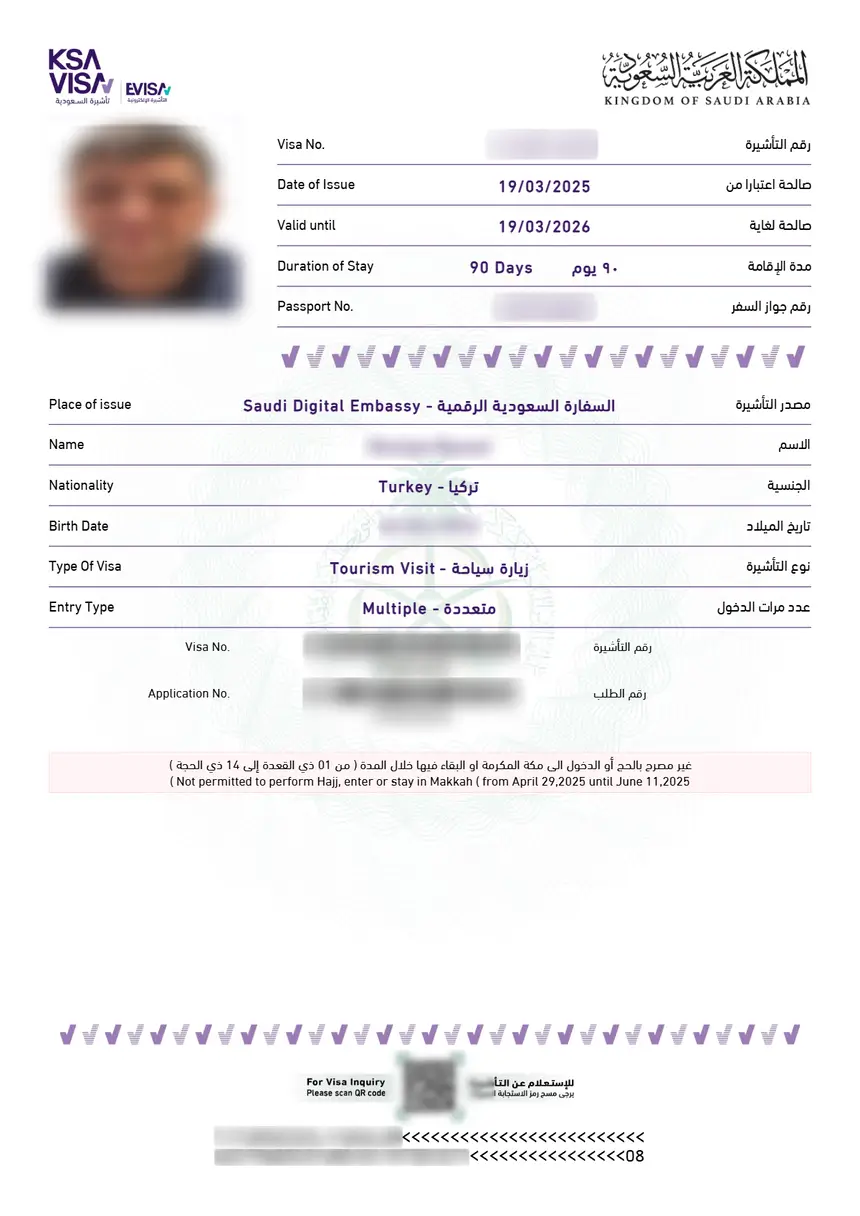
A Saudi Arabia transit visa is an official travel document issued by the Saudi Ministry of Foreign Affairs (MOFA) that authorizes passengers to pass through Saudi international airports on connecting flights. It is designed specifically for travelers whose final destination is outside Saudi Arabia.
The Saudi transit visa differs from other Saudi visa types in several key ways:
- Fee: SAR 100-200 (approximately USD 27-53)
- Validity: 48-96 hours from the time of issuance
- Entry type: Single entry only
- Purpose: Airport transit, connecting flights, brief stopovers
- Processing time: 3-7 business days when applied through an embassy or online portal
A Saudi transit visa permits travelers to pass through immigration, collect baggage, and re-check in for connecting flights. It also allows short exits from the airport during extended layovers. However, it does not permit tourism, business activities, or Umrah participation.
For travelers who want to explore Saudi Arabia during a layover, the regular Saudi eVisa at SAR 395 offers a more flexible option that allows tourism and multiple entries over 1 year.
Do You Need a Transit Visa for Saudi Arabia?
Whether you need a Saudi transit visa depends on three critical factors: the length of your layover, whether you remain in the international transit zone, and whether your flights are booked on a single ticket.
You likely do NOT need a transit visa if:
- Your connecting time is 12 hours or less on the same ticket
- You stay within the international transit area (airside)
- You hold a valid Saudi eVisa or are a GCC citizen
- Your flights are on the same airline or alliance partner
You DO need a transit visa if:
- Your connecting time exceeds 12 hours
- You must pass through Saudi immigration (landside)
- Your flights are on separate tickets (self-connecting)
- You need to collect and re-check baggage
- You want to leave the airport during your layover
Passengers with a valid eVisa do not need a separate transit visa. The eVisa allows entry to Saudi Arabia for any purpose, including transit. For details on eVisa eligibility, see our Saudi eVisa requirements page.
GCC (Gulf Cooperation Council) citizens from Bahrain, Kuwait, Oman, Qatar, and the UAE have freedom of movement within Saudi Arabia and require no visa of any kind for transit or entry.
Saudi Arabia Transit Visa Requirements
To apply for a Saudi transit visa, you need the following documents:
- Valid passport: must have at least 6 months of remaining validity from your date of entry into Saudi Arabia
- Confirmed onward flight booking: proof of a connecting flight departing Saudi Arabia within the transit visa validity period
- Passport-sized photograph: recent photo meeting Saudi visa photo specifications
- Visa for final destination (if required): if your destination country requires a visa, you must show proof of valid authorization
- Completed application form: filled out online or at the embassy
Some nationalities may need additional documentation, such as proof of sufficient funds or hotel confirmation if the layover extends overnight. Indian, Pakistani, Filipino, and Egyptian passport holders should prepare these extra documents as a precaution.
The passport requirement of 6 months validity is strictly enforced. Airlines will deny boarding if your passport expires within 6 months of your Saudi transit date, even if the transit visa itself has been approved.
For comparison, the regular Saudi eVisa requirements are similar but include an additional health insurance component that is bundled into the eVisa fee.
Saudi Transit Visa Cost and Validity
The Saudi Arabia transit visa costs between SAR 100 and SAR 200 (approximately USD 27-53), depending on the transit type and duration. This makes it significantly cheaper than the tourist eVisa at SAR 395.
| Feature | Transit Visa | Tourist eVisa |
|---|---|---|
| Fee | SAR 100-200 (~USD 27-53) | SAR 395 (~USD 105) |
| Validity | 48-96 hours | 1 year |
| Max stay | 48-96 hours | 90 days total |
| Entry type | Single | Multiple |
| Health insurance | Not included | Included |
| Tourism allowed | No | Yes |
| Umrah allowed | No | Yes |
The transit visa fee is paid online during the application process via credit or debit card. Embassy applications may also accept bank transfers or cash payments at the consulate.
Health insurance is not included in the transit visa fee, unlike the tourist eVisa which bundles mandatory insurance. If you plan to leave the airport during your layover, consider purchasing travel insurance separately.
For a detailed breakdown of all Saudi visa costs, see our Saudi eVisa fees and costs guide.
How to Apply for a Saudi Transit Visa
There are three ways to apply for a Saudi transit visa:
Method 1: Online Application
- Visit the official Saudi MOFA visa portal at visa.mofa.gov.sa or ksavisa.sa
- Create an account and select “Transit Visa” as the visa type
- Fill in personal details, passport information, and flight itinerary
- Upload a passport photo and scan of your passport bio page
- Pay the transit visa fee via credit or debit card
- Wait for approval, typically 3-7 business days
Method 2: Saudi Embassy or Consulate
- Contact your nearest Saudi embassy or consulate
- Submit a completed visa application form with required documents
- Pay the visa fee at the embassy
- Processing takes 3-7 business days in most cases
Method 3: Through Your Airline
Some airlines, particularly Saudi carriers like Saudia, Flynas, and Flyadeal, offer transit visa facilitation for passengers with extended layovers. Contact your airline directly to check if this service is available for your booking.
Important: Apply at least 7-10 days before your travel date to allow for processing time and any potential delays. Rush processing is not always available for transit visas.
Saudi Transit Visa vs eVisa for Layovers
If you have a long layover in Saudi Arabia and want flexibility, the regular eVisa may be a better choice than a transit visa. Here is how they compare:
| Criterion | Transit Visa | eVisa |
|---|---|---|
| Best for | Short layovers under 96 hours | Extended stops, tourism, Umrah |
| Fee | SAR 100-200 | SAR 395 |
| Validity | 48-96 hours | 1 year, multiple entries |
| Processing | 3-7 days | 24-48 hours |
| Tourism | No | Yes |
| Umrah | No | Yes (outside Hajj season) |
The eVisa at SAR 395 is a better value if your layover exceeds 48 hours or if you plan to visit Saudi Arabia again within the next year. It processes faster (typically 24-48 hours), includes health insurance, and allows you to combine transit with tourism.
For travelers on multi-city trips through the Middle East, the eVisa provides the freedom to enter and exit Saudi Arabia multiple times over its 1-year validity. Learn more in our complete Saudi eVisa guide.
The transit visa remains the best option for passengers who only need a brief, single-instance passage through Saudi Arabia and want to minimize costs.
Airside Transit vs Landside Transit in Saudi Arabia
Understanding the difference between airside and landside transit is essential for determining whether you need a Saudi transit visa.
Airside transit means staying within the international transit zone of the airport without passing through Saudi immigration. Passengers remain in a controlled area between arrival and departure gates. For airside transit in Saudi Arabia:
- No visa is typically required for layovers under 12 hours
- You do not need to collect checked baggage
- Your airline transfers your baggage to the connecting flight
- You cannot leave the airport or access Saudi territory
Landside transit means clearing Saudi immigration and entering the country, even briefly. You need a landside transit visa when:
- Your layover exceeds 12 hours and you want to rest outside the airport
- You must collect and re-check baggage (common with separate tickets)
- Your connecting flight departs from a different terminal or airport
- You want to leave the airport to explore, eat, or stay at a hotel
Saudi international airports in Jeddah, Riyadh, and Dammam have modern transit facilities with lounges, restaurants, and sleeping pods for airside passengers. However, comfort options are limited compared to major transit hubs like Dubai or Doha. Passengers with layovers exceeding 6 hours may prefer landside transit and a hotel stay, which requires a transit visa.
Saudi Arabia 12-Hour Transit Rule Explained
The 12-hour rule is a key threshold for Saudi Arabia transit. Under this rule, passengers with a connecting time of 12 hours or less on the same ticket and same airline (or alliance partner) generally do not need a transit visa, provided they remain in the international transit area.
Key conditions for the 12-hour exemption:
- Your flights must be on a single booking (same ticket/booking reference)
- You must remain airside (in the international transit zone)
- Your checked baggage must be transferred automatically by the airline
- You must have a valid boarding pass for your onward flight
Beyond 12 hours: If your connecting time exceeds 12 hours, airlines and Saudi immigration authorities may require a transit visa, even if you plan to stay airside. This threshold is not always strictly enforced, but relying on exceptions is risky. Check with your airline and the nearest Saudi embassy before travel.
Separate tickets: If you booked your flights on two separate tickets (self-connecting), the 12-hour exemption does not apply regardless of the layover duration. You will need a transit visa to pass through immigration, collect your baggage, and check in for your second flight.
Transit Visa for Specific Nationalities
Saudi Arabia transit visa requirements vary by nationality. Some nationalities face exemptions, while others require documentation even for brief airside transits.
| Nationality | Transit Visa Required? | Notes |
|---|---|---|
| United States | No (under 12h airside) | eVisa available for longer stays |
| United Kingdom | No (under 12h airside) | eVisa or ETA available |
| EU/Schengen | No (under 12h airside) | eVisa available |
| GCC citizens | No | Freedom of movement |
| India | Yes | Apply through embassy or airline |
| Pakistan | Yes | Apply through embassy or airline |
| Philippines | Yes | Apply through embassy or airline |
| Egypt | Yes | Apply through embassy or airline |
| Indonesia | Yes | Apply through embassy or airline |
| Bangladesh | Yes | Apply through embassy or airline |
| Israel | No (refused) | Israeli passports generally refused transit |
Indian and Pakistani citizens represent the largest group of transit passengers through Saudi airports, particularly for flights connecting South Asia to Europe and North America. These nationalities should apply for a transit visa well in advance, as processing may take longer during peak travel seasons.
Passengers with US, UK, or Schengen residency permits may also be eligible for a Saudi eVisa on arrival through Saudi airlines (Saudia, Flynas, Flyadeal) since January 2020. This eliminates the need for a separate transit visa application.
Israeli passport holders are generally refused entry and transit in Saudi Arabia. Exceptions exist only for specific business purposes authorized by MOFA.
Saudi Airports for Transit Passengers
Saudi Arabia has four main international airports serving transit passengers:
| Airport | Code | City | Transit Facilities |
|---|---|---|---|
| King Abdulaziz International | JED | Jeddah | Largest hub, Saudia primary base, new Terminal 1 |
| King Khalid International | RUH | Riyadh | Second-largest, modern transit facilities |
| King Fahd International | DMM | Dammam | Eastern Province hub, serves Bahrain traffic |
| Prince Mohammad bin Abdulaziz | MED | Medina | Limited international flights, Hajj/Umrah focus |
Jeddah (JED) is the primary transit hub for Saudi Arabia and the base for Saudia Airlines. The airport’s new Terminal 1, opened in 2024, features modern transit lounges, sleeping pods, and duty-free shopping. Most transit passengers connecting between Asia, Africa, and Europe pass through Jeddah.
Riyadh (RUH) serves as the capital city’s airport with growing international connections. Flynas and Flyadeal also operate from Riyadh.
Dammam (DMM) serves the Eastern Province and is a popular transit point for passengers traveling between the Gulf states, particularly via the King Fahd Causeway connecting Saudi Arabia to Bahrain.
Medina (MED) primarily serves Hajj and Umrah pilgrims. During Hajj season, flights to Medina and Jeddah are restricted to Hajj visa holders only, which can affect transit passengers. Check flight restrictions before booking connections through Medina during the Hajj period.